Why Honest Language Makes a Huge Positive Impact in Incontinence Care

Key Takeaways
-
The incontinence industry has spent decades avoiding the word "diaper" — calling products briefs, protective underwear, or absorbent guards — and that avoidance quietly reinforces the idea that what someone is managing is too embarrassing to name directly.
-
When people can't say the word for what they're wearing, they're less likely to ask whether they're wearing the right one, less likely to tell a doctor how bad things have gotten, and less likely to find protection that actually matches their needs.
-
Research commissioned by NorthShore found that 74% of incontinence product buyers report symptoms that go beyond drips and dribbles — yet most continue using products designed for light leaks, partly because honest conversations about heavier needs aren't happening.
-
Direct language isn't unkind. It's the foundation of real support — and the more openly incontinence is discussed, the easier it becomes for someone to recognize their situation, ask for help, and stop managing alone.
There is one word the incontinence industry has spent decades avoiding.
Not "leaks." Not "accidents." Not even "incontinence" itself, which has at least found its way into clinical conversation. The word the industry treats as unspeakable — on packaging, in clinical settings, in advertising, and in everyday conversation — is "diaper."
Healthcare providers call them briefs. Retailers call them protective underwear, guards, or liners. Manufacturers call them absorbent products. Almost nobody calls them what they are.
That avoidance isn't neutral. Every time the word "diaper" gets replaced with a softer term, it quietly reinforces the idea that the real word is too embarrassing to say — and that whatever someone is managing must be too embarrassing to talk about directly.
For the millions of people managing Heavy Bladder Leaks (HBL) — symptoms that go well beyond the occasional drip — that silence has real consequences. It delays conversations with doctors. It keeps people using products that don't work. And it makes an already isolating experience feel more shameful than it needs to be.
The Six-to-Eight-Year Gap
On average, people wait six to eight years before talking to a healthcare provider about incontinence symptoms. That delay has persisted through decades of the industry using softer language, discreet packaging, and euphemisms designed to make the topic feel less embarrassing.
The connection between language and help-seeking is direct. When people can't find words for what they're experiencing — or when the words available make them feel ashamed — they delay. They minimize. They manage in silence. And they often do it with products that weren't built for what they're actually dealing with.
Calling something what it is makes it possible to talk about it honestly, choose it deliberately, and advocate for better options without shame. That's not a small thing. For a lot of people, it's the difference between years of unnecessary leaks and finally finding something that works.
The Word Nobody Wants to Say — and Why That Matters
Walk into any pharmacy and look at the incontinence aisle. The word "diaper" appears almost nowhere. Products are labeled as protective underwear, bladder control pads, absorbent briefs, or adult guards. The packaging is designed to look as unlike a diaper as possible — thin profiles, pastel colors, language borrowed from athletic wear.
Healthcare providers often follow the same convention. "Brief" is the clinical standard. "Diaper" is considered undignified, infantilizing, or inappropriate for adult patients.
The irony is that the avoidance often makes things worse. When people can't say the word for what they're wearing, they're less likely to ask whether they're wearing the right one. They're less likely to tell a doctor how often it leaks. They're less likely to describe what's actually happening, because the whole topic has been coded as something that shouldn't be discussed directly.
NorthShore uses the words "adult diapers" in its advertising, on its website, and in its customer communications — not to be provocative, but because direct language is the foundation of direct help. The more people see and hear those words without flinching, the easier it becomes to say them — and to start the conversations that actually lead somewhere useful.
The Difference Between Light Leaks and Heavy Bladder Leaks
Not all bladder leaks are the same, and the gap between light bladder leakage (LBL) and HBL is larger than most people realize.
Someone managing a few drops while coughing or sneezing has genuinely different needs from someone experiencing overnight wettings, urgency accidents, or repeated full bladder voids throughout the day. Yet most products on the market — including many labeled "maximum," "overnight," or "extended wear" at major retailers — are designed for the lighter end of the spectrum.
NorthShore-commissioned research conducted by PDG Insights among 418 U.S. incontinence product buyers found that 74% of respondents said their leakage goes beyond drips and dribbles. More than half reported doubling up on products. And 73% said they were not confident their current product wouldn't leak.
That's not a product failure. That's a language failure — one that starts when people don't feel comfortable saying clearly what's happening, and continues when the products marketed to them don't clearly say what they're built to handle.
When language stays vague, people end up buying products based on what feels emotionally comfortable rather than what actually works for their bodies. Light liners are built for minor leaks. Moderate absorbency products support lighter daily wettings. HBL requires products designed for multiple wettings, overnight protection, and larger voids — and knowing that distinction exists is the first step toward finding protection that actually works.
Why Honest Product Language Matters
Over 90% of incontinence product buyers said they would prefer better drying and leak protection over thinner products — yet the retail category continues to center its message on thinness and discretion.
The underlying problem is that a discreet product that leaks is not actually discreet. Honest language about what products can handle helps reduce the trial-and-error frustration that comes from choosing protection based on packaging rather than performance.
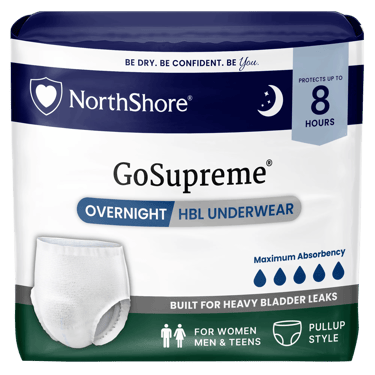
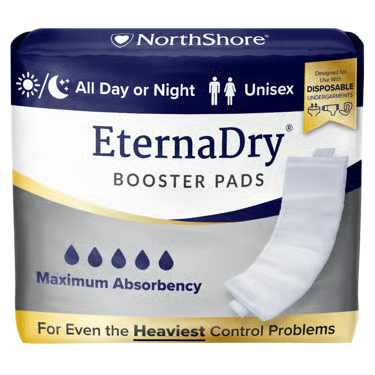
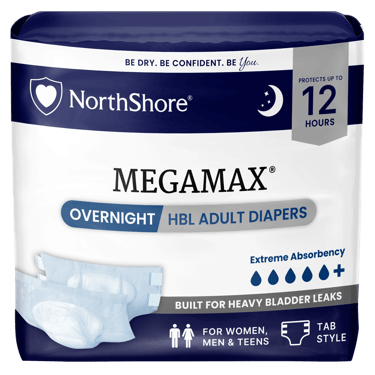
MegaMax® tab-style adult diapers are designed for HBL and multiple voids, with MVP™ (Multi-Void Protection) technology that keeps skin dry through up to 12 hours of extended wear. GoSupreme® pull-up style underwear offers an underwear-like fit for active daytime routines while still supporting HBL needs with up to 8 hours of protection. For people managing heavier overnight wettings or longer stretches between changes, EternaDry® Booster Pads can add extra absorbency inside any brief or pull-up without needing to size up the primary product.
Being specific about what products are designed to handle can eliminate years of unnecessary leaks, skin irritation, and interrupted sleep.
*An immediate change is required after a bowel movement.
Caregiving Conversations Often Depend on Language
Language matters significantly when caregivers are involved.
A rushed, dismissive, or infantilizing tone can make adults feel humiliated quickly. Practical, respectful language can preserve dignity even during difficult care situations. The difference between "let's get you cleaned up" and "would you like help getting comfortable?" is small in words and significant in experience.
For caregivers supporting someone through mobility changes, dementia, stroke recovery, spinal cord injuries, or chronic illness, respectful communication often becomes part of the care itself — not separate from it.
Specific phrases that tend to land well:
-
"Would you like help changing?"
-
"How has this product been working for you?"
-
"Do you feel dry enough overnight?"
-
"Let's find something more comfortable."
These questions center the person being cared for rather than the inconvenience of the situation. That distinction matters enormously in long-term caregiving relationships.
Why Euphemisms Sometimes Create More Shame
Many people assume softer language automatically feels kinder. But consistently avoiding direct conversation can reinforce the idea that incontinence is too embarrassing to discuss honestly — even with a doctor.
When the cultural message is that incontinence should always be hidden, whispered about, or managed invisibly, people internalize that message. They stop asking for help. They stop asking questions in medical appointments. They settle for products that don't work because admitting they need something stronger feels like admitting something worse about themselves.
Incontinence is very common, often treatable, and can be very manageable. Clear language helps move the conversation from shame toward practical support. And that shift starts with being willing to say what's actually happening — to a doctor, a caregiver, a family member, or even to oneself.
The NorthShore Hero Club is a community of customers and caregivers who have chosen to share their experiences openly — because every story shared makes it a little easier for the next person to take their first step. Read stories and, when ready, share your own.
Honest Conversations Help Healthcare Visits
People managing bladder or bowel symptoms routinely minimize them during medical appointments.
They say things like "it's just occasional," "it's probably nothing," or "I'm mostly fine" — while waking multiple times a night, changing clothing regularly, and avoiding travel, social plans, or activities they once loved.
More specific language gives healthcare providers a clearer picture. Useful details include:
-
Overnight wettings
-
Sudden urgency with little warning
-
Leaks during exercise or physical activity
-
Difficulty reaching the bathroom in time
-
Full bladder voids rather than drips
-
Skin irritation from moisture exposure
-
Bowel leaks alongside urinary symptoms
-
How often current products fail or require doubling up
"I leak sometimes" describes something very different from "I wake up two to three times overnight and my product has failed by morning." Both are true for the same person. Only one of them gives a provider enough information to help.
Dignity Starts With Being Understood
For many people, the hardest part of incontinence isn't the physical symptom. It's feeling misunderstood, dismissed, or alone with something that millions of people are quietly navigating at the same time.
Honest language can't remove every challenge. But it can make people feel more informed, more respected, and more supported while they figure out what actually works for their body and their life.
Reliable products, realistic expectations, and direct conversations make daily life more manageable than silence and guesswork ever have.
NorthShore's Sample Program offers up to 6 free samples — take a quick 4-question quiz to get matched with the right options and try them at home. Orders placed by 7pm Central in the contiguous U.S. ship same day in discreet, unmarked boxes. Shipping charges apply.
NorthShore's Care Experts are real people available by call, text, or chat 7 days a week — ready to answer questions honestly about absorbency, fit, overnight protection, mobility needs, and HBL support, all judgment-free. They can also place a sample order directly.
Frequently Asked Questions
Why does the incontinence industry avoid the word "diaper"?
The word "diaper" has long been associated with infants, and the industry has consistently avoided it for adult products out of concern it would feel undignified or embarrassing. Products are instead labeled as briefs, protective underwear, or absorbent guards. But that avoidance has a cost — when people can't say the word for what they're wearing, they're less likely to ask whether they're wearing the right one or to describe their needs accurately to a healthcare provider.
Why does language matter in incontinence care?
Language shapes how people understand their symptoms, whether they seek help, and whether they find products that actually match their needs. When incontinence is consistently described through euphemisms or minimizing terms, people often delay healthcare conversations and continue using products that weren't designed for their level of need. Research shows people wait an average of six to eight years before talking to a provider — and that delay is directly connected to stigma and the language that reinforces it.
What is Heavy Bladder Leaks (HBL)??
Heavy Bladder Leaks (HBL) refers to larger or more frequent wettings that require higher-absorbency products than light liners or store-brand options designed for occasional drips. HBL can involve multiple full bladder releases, overnight wettings, urgency accidents, or leaks that disrupt sleep, work, travel, and daily routines. According to NorthShore-commissioned research, 74% of incontinence product buyers report symptoms that go beyond drips and dribbles.
Why do people avoid talking openly about incontinence?
Many people connect incontinence with aging, loss of independence, or being viewed differently by partners and family. That emotional weight often makes vague or minimizing language feel safer than direct conversation — even with healthcare providers. The result is delayed diagnosis, continued use of inadequate products, and the kind of quiet isolation that a more open conversation could help address.
What products are designed for Heavy Bladder Leaks?
MegaMax® tab-style adult diapers and GoSupreme® pull-up style underwear are both designed specifically for HBL — engineered for multiple voids, extended wear, and overnight protection that store-brand products marketed for light leaks are not built to provide. EternaDry® Booster Pads can extend absorbency further without changing the primary product.
How can someone describe their symptoms more clearly to a healthcare provider?
Rather than saying "I have occasional leaks," try being specific: how often leaks happen, whether they occur overnight, whether urgency is involved, whether current products fail, and how symptoms affect daily activities like sleep, travel, work, and exercise. The more specific the picture, the better a provider can assess underlying causes and recommend appropriate treatment or referrals.
Products Mentioned In This Article
More Helpful Tips & Resources


About NorthShore Care Supply
Founded in 2002, NorthShore Care Supply helps individuals and caregivers find the right protection for heavier leaks, overnight needs, and daily confidence. As the maker of NorthShore® Adult Diapers, we lead in high-performance protection for Heavy Bladder Leaks (HBL) and support #EndHealthStigma. Our expert Customer Care team provides private, compassionate guidance to help people choose products that fit their needs and lifestyle. Follow us on LinkedIn and Facebook @NorthShoreCareSupply, Twitter, Instagram and TikTok @NorthShoreCare.
Access your List
Connect on social:


