Heavy Bladder Leaks Are Common. The Silence Around Them Doesn't Have to Be.

Key Takeaways
-
Urinary incontinence affects more than 400 million people worldwide and nearly 100 million Americans, yet the average person waits seven years before raising it with a healthcare provider.
-
The cost of that silence is measurable: 48.7% of women with urinary incontinence report impaired quality of life, and people with daily leaks are more than twice as likely to experience social isolation.
-
Most retail products are engineered for light bladder leakage, which is why 73% of buyers say they are not confident retail products will hold. Products built for Heavy Bladder Leaks (HBL) are designed for a different job entirely.
Some people reroute a road trip to avoid highways with no exits. Some turn down a dinner invitation because the bathroom might not be close enough. Some quietly layer extra pads, hope for the best, and tell no one.
If that sounds familiar, here’s something research confirms: you’re not alone, and this is not a personal failing. Adult incontinence is one of the most widespread health conditions in the United States and one of the most undertreated, precisely because stigma keeps millions of people from ever asking for help.
The Numbers Tell a Story Most People Never Hear
According to the National Institute of Diabetes and Digestive and Kidney Diseases (NIDDK), approximately half of all women in the United States experience urinary incontinence at some point in their lives. As many as one in three men over 65 also experience accidental urine loss. And those figures only scratch the surface, the National Association for Continence (NAFC) estimates that nearly 100 million Americans live with urinary incontinence or another bladder condition.
Globally, a 2025 scoping review published in Nursing Reports (PMC) found that urinary incontinence affects more than 400 million people over age 20, more than 20% of the world's adult population.
These aren’t fringe statistics. Bladder leakage affects people across every age, gender, and background: new mothers, veterans, people managing neurological conditions, adults navigating aging. It is, in the NAFC’s words, not an inevitable or normal part of getting older. It’s a medical reality that deserves the same straightforward conversation as any other health condition.
Heavy Bladder Leaks Are Not Light Bladder Leaks
There’s an important distinction that often gets lost. Light bladder leakage, such as a few drips and dribbles triggered by something like a sneeze or a laugh, is what most mainstream advertising addresses. Heavy bladder leaks (HBL) are something different: full or near-full bladder releases, repeated voids, overnight flooding, and the kind of volume that renders a standard drugstore pad useless within the hour.
Research commissioned by NorthShore and conducted by PDG Insights found that 74% of adult incontinence product buyers have needs that go well beyond light drips and dribbles, yet most retail shelves are stocked almost entirely for the light end of the spectrum.⁷ That mismatch has consequences.
Why Do People Wait So Long to Seek Help for Bladder Leaks?
People living with bladder leakage don't just manage a physical challenge. They carry the weight of a social stigma that pushes this condition into the shadows, away from doctors' offices, away from family conversations, away from any chance of real support.
According to the NAFC, the average time between the onset of incontinence symptoms and the first conversation with a healthcare provider is seven years. A survey commissioned by NorthShore cited a similar figure: 6 to 8 years. That is years of canceled plans, improvised workarounds, sleep disrupted by leaks, and a growing sense that this is simply something to be quietly endured.
The NAFC also reports that only 1 in 3 people with incontinence will ever seek treatment and among those who do, about 27% still haven't talked honestly with their doctor about their symptoms, even when they feel frustrated enough to take some action. A 2007 study published in the Journal of Urology (Harris et al.) found that only 45% of women with weekly incontinence had ever sought care, and only 22% of men had done the same.
The primary reason for staying silent? Shame.
The Emotional and Social Toll Is Real and Documented
The consequences of untreated incontinence extend well beyond wet clothing. A 2023 study published in Healthcare (PMC) found that among women living with urinary incontinence:
-
48.7% reported an impaired quality of life
-
34.2% experienced moderate to severe psychological distress
-
34.6% had low self-esteem as measured by the Rosenberg Scale
An NAFC survey found that nearly 90% of respondents reported feeling depressed, isolated, or hopeless because of their condition.
Social withdrawal is one of the most consistent downstream effects. The 2025 Nursing Reports scoping review found that women with daily urinary incontinence were more than twice as likely to report social isolation compared to their non-incontinent peers, at 6.6% versus 2.6%.⁴ Older adults with urinary incontinence had 80% higher odds of loneliness in one Canadian study of more than 16,000 seniors, and in a U.S. study of older adults, greater urine loss predicted greater social restriction with an odds ratio of 3.47.⁴
One-third of older adults with incontinence in one study were classified as homebound, leaving the house once a week or less.⁴
This is what stigma costs. It isn’t abstract discomfort. It’s people declining invitations, skipping exercise, missing work, pulling away from the relationships and activities that make daily life meaningful.
How Isolation Compounds the Psychological Impact
It’s worth noting that the relationship between incontinence and depression isn’t simply one of cause and effect. The Nursing Reports review found that depression acts partly as a mediator between incontinence and loneliness, meaning reduced social connection and reduced social activity together account for roughly 20% of the association between urinary incontinence and depressive symptoms.⁴
In other words, the isolation driven by stigma compounds the psychological impact. Addressing the stigma, and finding real-world support, isn’t a luxury. It’s part of the care.
Why Retail Products Fall Short for Heavy Leaks
People living with heavy bladder leaks frequently describe the same frustrating cycle: they buy a product labeled “maximum” or “overnight” at the pharmacy, it leaks within a few hours, and they conclude, wrongly, that nothing is going to work.
The NorthShore-commissioned survey found that 73% of incontinence product buyers are “not very confident” that retail products won’t leak.⁷ That’s not a product preference problem. That’s a design gap: most mass-market products are engineered for light leakage, regardless of what the packaging suggests.
“Thinner is not always better,” as NorthShore puts it in its first national TV campaign, launched in 2026.⁷ When it comes to heavy bladder leaks, a thinner product isn’t progress. It’s a leak waiting to happen.
Real Protection, Real Support: What NorthShore Offers
NorthShore was founded in 2002 specifically for people who need more than what a retail aisle can offer. The company has since served more than 3 million individuals, caregivers, and families, building a product line and a service model around one principle: protection that actually holds.
NorthShore’s lineup is designed from the ground up for moderate to heavy incontinence, not as an afterthought to a product made for lighter leakage:
-
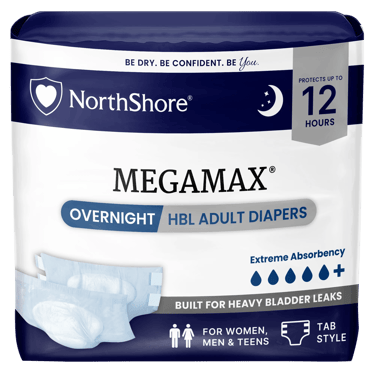
MegaMax® 12-Hour Tab-Style Adult Diapers: Up to 12 hours of MVP™ (Multi-Void Protection), engineered to handle repeated full bladder releases, including overnight flooding, without leaking.
-
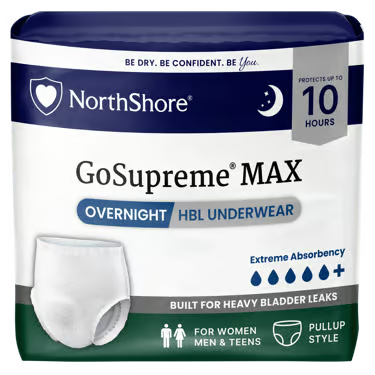
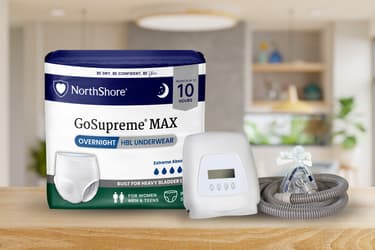
GoSupreme® Max 10-Hour Pull-Up Underwear: The brand’s highest-absorbency pull-up, offering up to 10 hours of protection in a more independent-friendly format.
-
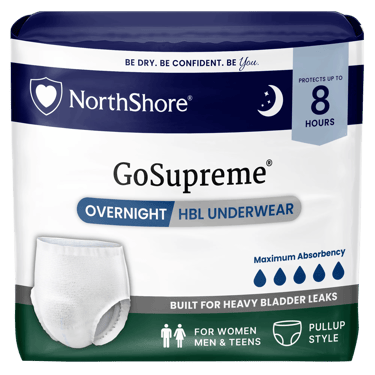
GoSupreme® 8-Hour Pull-Up Underwear: A top seller for moderate-to-heavy leakage with a familiar underwear fit.
-
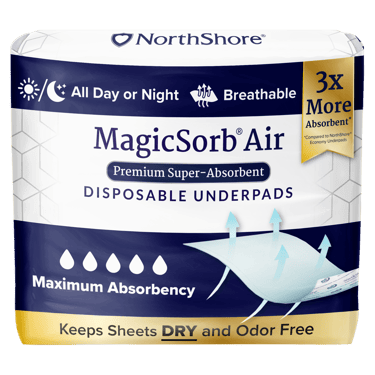
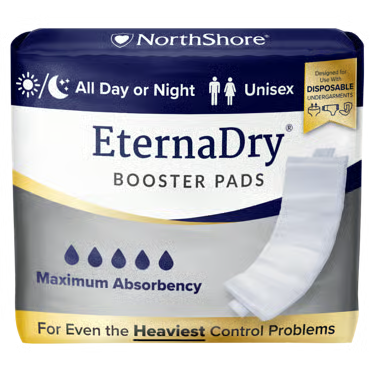
MagicSorb® Air Underpads and EternaDry® Booster Pads: Add-on protection for beds, chairs, or inside existing garments, practical for caregivers and people managing overnight leaks.
Products are available in real sizing across a wide range. The NorthShore Sample Program pairs a quick 4-question quiz with up to 6 free samples, so different options can be tested at home before committing to a full order. Orders placed by 7pm Central in the contiguous U.S. ship same day in discreet, unmarked boxes. Shipping charges apply.
Guidance Without Judgment
Buying incontinence products is often frustrating and quietly humiliating when the right choice isn’t obvious and the options at the store don’t fit or work. NorthShore’s U.S.-based Care Experts are available seven days a week by phone, text, email, or chat to help with product selection, sizing, and any questions about managing heavy leaks. They can also place a sample order directly. No guesswork, no awkward returns.
You Are Part of a Larger Community
Bladder leakage isn’t a personal failing. It’s a medical condition that affects tens of millions of people who work, travel, sleep, love, and live full lives. The stigma that surrounds it has real consequences: delayed care, worsening depression, growing isolation, and years of managing alone with products that weren’t built for the job.
But that silence isn’t inevitable. Researchers are studying it. Advocacy organizations are naming it. The NorthShore Hero Club™ is full of customers and caregivers who decided to say it out loud so the next person wouldn’t have to figure it out alone. Read through stories and, when you’re ready, feel free to share your own.
Protection that works exists. Support without judgment exists. And there is a difference between managing around a life and actually living it.
Frequently Asked Questions
How common is urinary incontinence?
Approximately half of women in the United States experience urinary incontinence at some point, and as many as one in three men over 65 experience accidental urine loss.¹ The National Association for Continence estimates nearly 100 million Americans live with urinary incontinence or another bladder condition,³ and globally the figure exceeds 400 million adults.⁴
What is the difference between light bladder leakage and heavy bladder leaks?
Light bladder leakage means a few drops triggered by a sneeze, laugh, or cough. Heavy bladder leaks (HBL) involve full or near-full bladder releases, repeated voids, and overnight flooding. Most retail products are engineered for the light end of that spectrum, which is why 74% of buyers report needs that go beyond what those products can handle.⁷
Why do people wait so long to talk to a doctor about bladder leaks?
The average delay between symptom onset and the first conversation with a provider is seven years, and only 1 in 3 people with incontinence ever seek treatment.² The most commonly cited reason is shame. Even among those who do seek care, roughly 27% have not described their symptoms honestly to their doctor.²
Can incontinence cause depression or social isolation?
Research documents both. Nearly 90% of respondents in one NAFC survey reported feeling depressed, isolated, or hopeless because of their condition.² Women with daily urinary incontinence are more than twice as likely to report social isolation, and one study found a third of older adults with incontinence were classified as homebound.⁴
Why do store-brand overnight products still leak?
Most mass-market products are designed for light bladder leakage regardless of what terms like “maximum” or “overnight” suggest on the packaging. Research found 73% of buyers are not confident retail products will hold.⁷ Products built specifically for HBL, like MegaMax® and GoSupreme® Max, are engineered for repeated full bladder releases.
What are the best adult diapers for heavy bladder leaks?
It depends on preferred style and wear time. MegaMax® tab-style adult diapers offer up to 12 hours of protection for the heaviest needs. GoSupreme® Max provides up to 10 hours in a pull-up format, and GoSupreme® offers up to 8 hours with a familiar underwear fit. The Sample Program is the simplest way to compare at home.
Sources:
-
NIDDK — Definition & Facts for Bladder Control Problems — National Institute of Diabetes and Digestive and Kidney Diseases, NIH
-
NAFC — Overcoming the Stigma of Incontinence — National Association for Continence (7-year average delay; 1 in 3 seek treatment; 90% depression/isolation stat; 27% haven't talked to a doctor)
-
NAFC — Incontinence by the Numbers — National Association for Continence (~100 million Americans; 54% of women; 15% of men; rising prevalence)
-
PMC12655203 — Social Isolation Among Individuals with Incontinence: A Scoping Review — Nursing Reports, 2025 (400M globally; social isolation OR=2.1–3.47; 32.9% homebound; depression mediation at 20%)
-
PMC10297870 — Urinary Incontinence Affects Quality of Life and Increases Psychological Distress and Low Self-Esteem — Healthcare, 2023 (48.7% impaired QoL; 34.2% moderate-severe distress; 34.6% low self-esteem)
-
PubMed 17222656 — Harris et al., Care Seeking and Treatment for Urinary Incontinence in a Diverse Population — Journal of Urology, 2007 (45% of women, 22% of men with weekly UI ever sought care; 40% received no treatment)
-
PR Newswire — "Thinner Is Not Always Better": NorthShore Adult Diapers Launches First National TV Commercial — NorthShore/PDG Insights commissioned survey, 2026 (74% HBL needs beyond light leaks; 73% not confident in retail products; 90% prefer staying dry; 6–8 year delay)
-
NorthShore.com — Product specifications, brand story, and MVP™ technology details
Products Mentioned In This Article
More Helpful Tips & Resources


About NorthShore Care Supply
Founded in 2002, NorthShore Care Supply helps individuals and caregivers find the right protection for heavier leaks, overnight needs, and daily confidence. As the maker of NorthShore® Adult Diapers, we lead in high-performance protection for Heavy Bladder Leaks (HBL) and support #EndHealthStigma. Our expert Customer Care team provides private, compassionate guidance to help people choose products that fit their needs and lifestyle. Follow us on LinkedIn and Facebook @NorthShoreCareSupply, Twitter, Instagram and TikTok @NorthShoreCare.
Access your List
Connect on social:


